Best Egnyte Alternatives in 2026
8 min read · 22.09.2026
Our Blog / opencloud-vs-nextcloud-which-open-source-cloud-platform-is-right-for-you-in-2026
← Back to overview
As organizations and individuals seek greater control over their data, open-source cloud platforms have become a practical alternative to proprietary services like Google Drive, Dropbox, and Microsoft 365. Among the growing number of available options, OpenCloud and Nextcloud stand out as two powerful solutions for self-hosted cloud storage and collaboration.
While both platforms share similar roots, they have evolved with different priorities and use cases in mind.
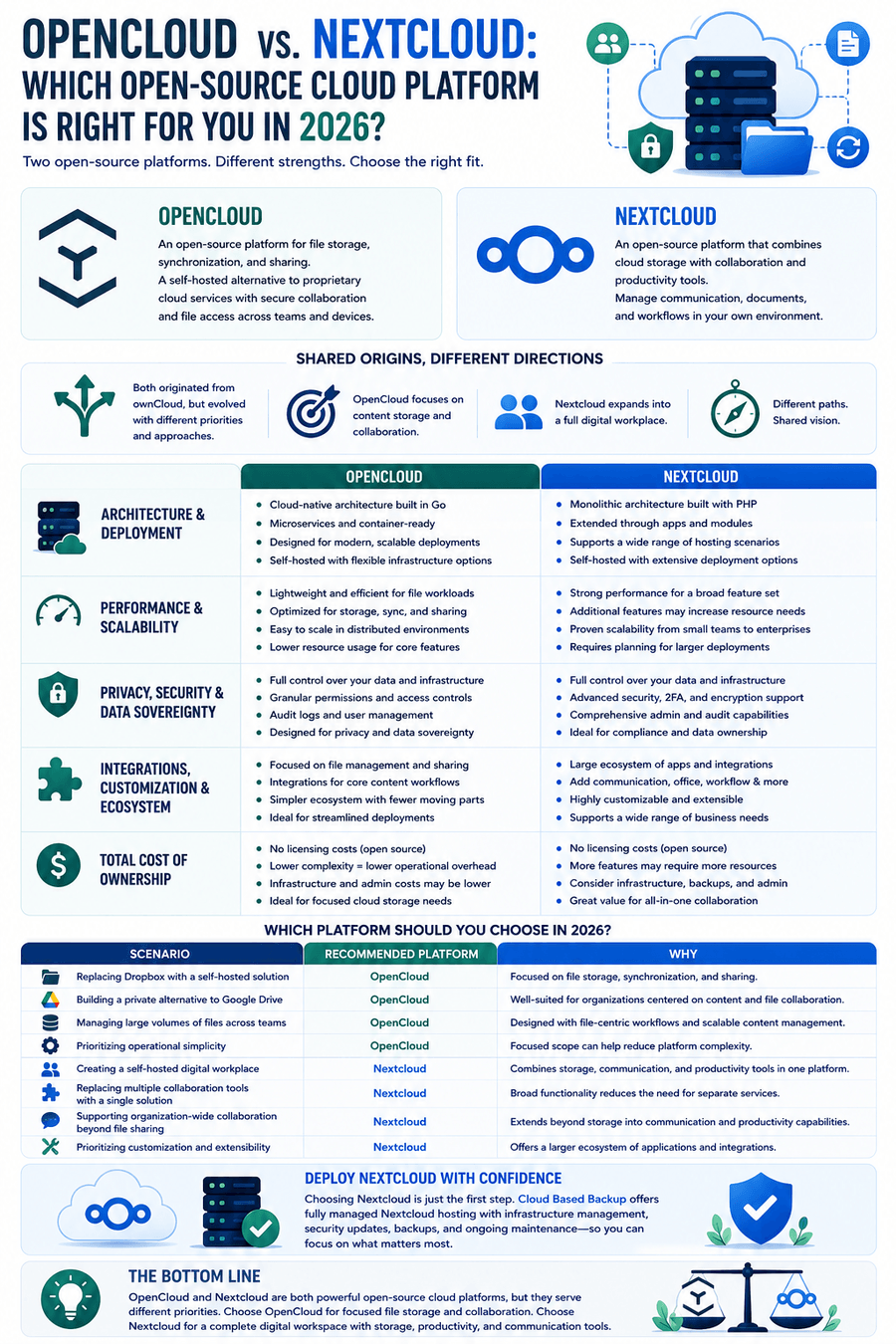
OpenCloud and Nextcloud are both open-source cloud platforms, but they are designed with different priorities in mind. OpenCloud is best suited for organizations focused on file storage, synchronization, sharing, and content collaboration. At the same time, Nextcloud is a broader platform that combines cloud storage with communication, productivity, and collaboration tools. The right choice depends on whether you need a dedicated self-hosted cloud storage solution or a more comprehensive digital workspace.
In this article, we'll compare OpenCloud and Nextcloud to help you understand their key differences and determine which platform is the right fit for your needs in 2026.
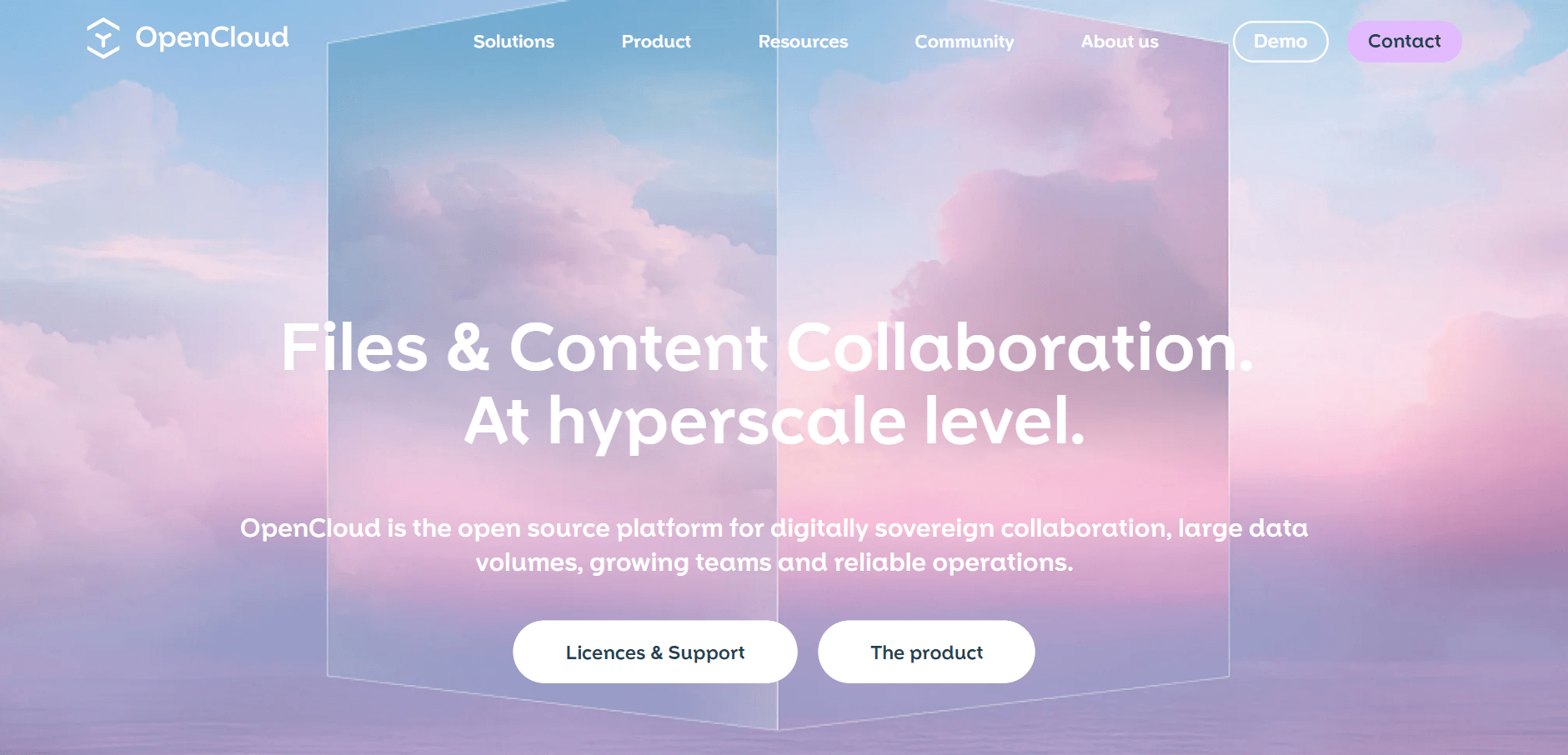
OpenCloud is an open-source platform for file storage, synchronization, and sharing. Designed for organizations and individuals that want greater control over their data, it provides a self-hosted alternative to proprietary cloud storage services while supporting secure collaboration and file access across teams and devices.
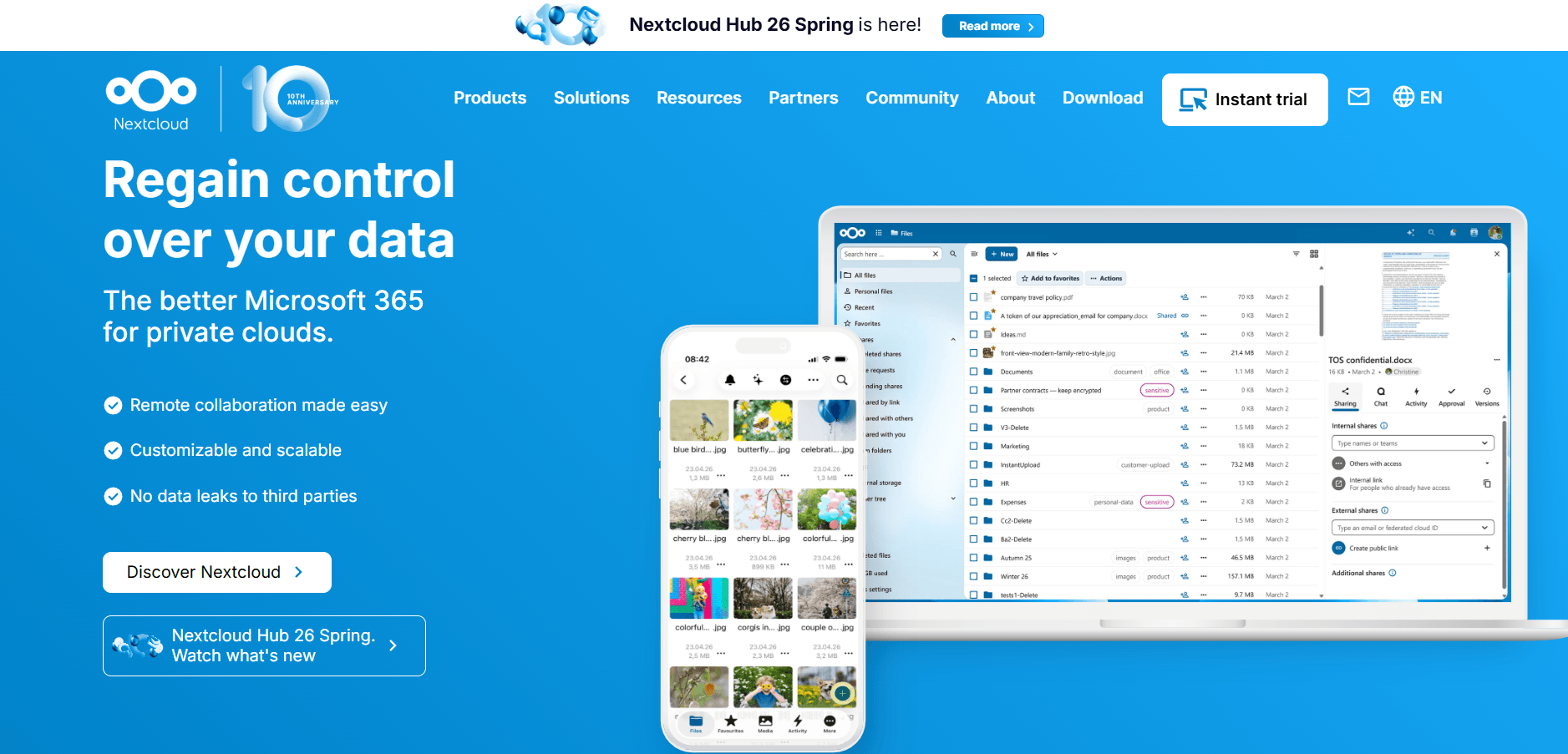
Nextcloud is an open-source platform that combines cloud storage with collaboration and productivity tools. Alongside file synchronization and sharing, it offers capabilities to help teams manage communication, documents, and day-to-day workflows in a self-hosted environment.
OpenCloud and Nextcloud share roots in the ownCloud ecosystem, but they have evolved in different directions over time. While both provide secure and private cloud solutions, their development priorities have shaped distinct approaches to storage, collaboration, deployment, and long-term platform strategy.
OpenCloud uses a cloud-native architecture developed in Go, with services designed to operate independently and support modern deployment environments. Nextcloud follows a more traditional monolithic architecture built primarily on PHP, where core functionality is delivered through a single application that can be extended through modules and apps.
These approaches reflect different design priorities and influence how each platform is deployed and managed.
Both platforms support self-hosting, giving organizations full control over their data and infrastructure. OpenCloud is designed with containerized and distributed deployments in mind, making it well-suited for environments that already rely on modern infrastructure practices.
Nextcloud offers a more established deployment model that supports a wide range of hosting scenarios, from personal servers to enterprise environments. The best choice often depends on an organization's existing infrastructure, deployment preferences, and administrative requirements.
OpenCloud's cloud-native architecture and Go-based foundation are designed to deliver efficient performance for file storage, synchronization, and sharing workloads. By focusing primarily on content management and collaboration, it can operate with a relatively lightweight infrastructure footprint.
Nextcloud also provides strong file sync and share capabilities. Still, its broader set of collaboration, communication, and productivity features can increase resource requirements, depending on deployment size and the number of services in use.
When it comes to scalability, both platforms can support growing organizations, but they approach expansion differently. OpenCloud was designed with distributed environments in mind, making it easier to scale storage and file-sharing workloads across modern infrastructure.
Nextcloud has a proven track record in deployments ranging from small teams to large enterprises, though scaling a broader collaboration platform may require additional infrastructure planning.
Privacy and data control are among the main reasons organizations choose self-hosted cloud storage over proprietary cloud services.
Both OpenCloud and Nextcloud allow organizations to host data on their own infrastructure, giving them full control over where information is stored, processed, and accessed. This approach supports data sovereignty requirements and helps organizations reduce dependence on third-party providers, making both platforms viable options for businesses that prioritize privacy, compliance, and data ownership.
From a security perspective, both platforms provide features designed to protect sensitive information and control access to resources. Administrative controls, user permissions, authentication options, and auditing capabilities help organizations manage security policies across their environments.
While the specific implementations may differ across platforms, both support the governance and access management requirements commonly expected of modern open-source cloud platforms.
OpenCloud maintains a focused approach centered on file storage, sharing, and content collaboration, with integrations designed to support these core functions. This can be advantageous for organizations that prefer a streamlined platform with fewer moving parts.
Nextcloud, on the other hand, is designed as a broader collaboration platform and supports a wide range of additional capabilities through its extensible architecture.
This difference is most visible in each platform's ecosystem. Nextcloud offers an extensive library of applications and integrations that enable organizations to add features such as document collaboration, communication tools, workflow automation, and productivity services. OpenCloud's ecosystem is more focused, prioritizing integrations that enhance file management and collaboration workflows.
For organizations evaluating an open-source cloud platform, the choice often comes down to whether they need a dedicated file-sharing solution or a platform that can be extended to support a wider range of business functions.
While OpenCloud and Nextcloud are open-source platforms, the overall cost extends beyond the software itself. Organizations must account for infrastructure, storage, backups, monitoring, and administrative resources required to keep the platform running reliably.
The scope of the deployment also plays a role, as larger environments typically require additional computing resources and operational oversight regardless of the platform chosen.
Maintenance, upgrades, and future growth often influence long-term costs. OpenCloud's focused approach may appeal to organizations looking to minimize operational complexity around file storage and sharing, while Nextcloud's broader feature set can provide greater functionality within a single platform.
For organizations that decide Nextcloud is the right fit, deployment and ongoing administration are important considerations. At Cloud Based Backup, we provide fully managed Nextcloud hosting that includes infrastructure management, security updates, backups, and ongoing maintenance, allowing organizations to benefit from Nextcloud's collaboration capabilities without the operational overhead of self-managing the platform.
If you're still evaluating cloud storage and collaboration platforms, these additional comparisons can help you better understand how Nextcloud stacks up against other popular solutions:
OpenCloud and Nextcloud are both capable open-source cloud platforms, but they are designed with different priorities in mind. OpenCloud is best suited for organizations primarily needing secure file storage, synchronization, sharing, and content collaboration. At the same time, Nextcloud is geared toward organizations seeking a broader collaboration platform that combines storage with productivity and communication tools.
There is no one-size-fits-all choice. The right platform depends on your requirements, infrastructure strategy, and long-term objectives. If your focus is building a dedicated self-hosted cloud storage environment, OpenCloud may be the better fit. If you're looking to create a more comprehensive digital workspace that integrates multiple collaboration features, Nextcloud offers a broader set of capabilities.
8 min read · 22.09.2026
5 min read · 14.09.2026
5 min read · 18.08.2026
Hosted in
Germany
4.3on G2