Best OneDrive Alternatives for Businesses in 2026
8 min read · 29.09.2026
Our Blog / pydio-cells-vs-nextcloud-which-self-hosted-cloud-storage-is-better
← Back to overview
As organizations place greater emphasis on data privacy, ownership, and compliance, self-hosted cloud storage has become a practical alternative to public cloud services. Platforms like Pydio Cells and Nextcloud allow businesses to store, manage, and share files on infrastructure they control while reducing reliance on third-party providers.
In this article, we'll compare Pydio Cells and Nextcloud to help you determine which platform is better suited to your security, collaboration, and deployment requirements.
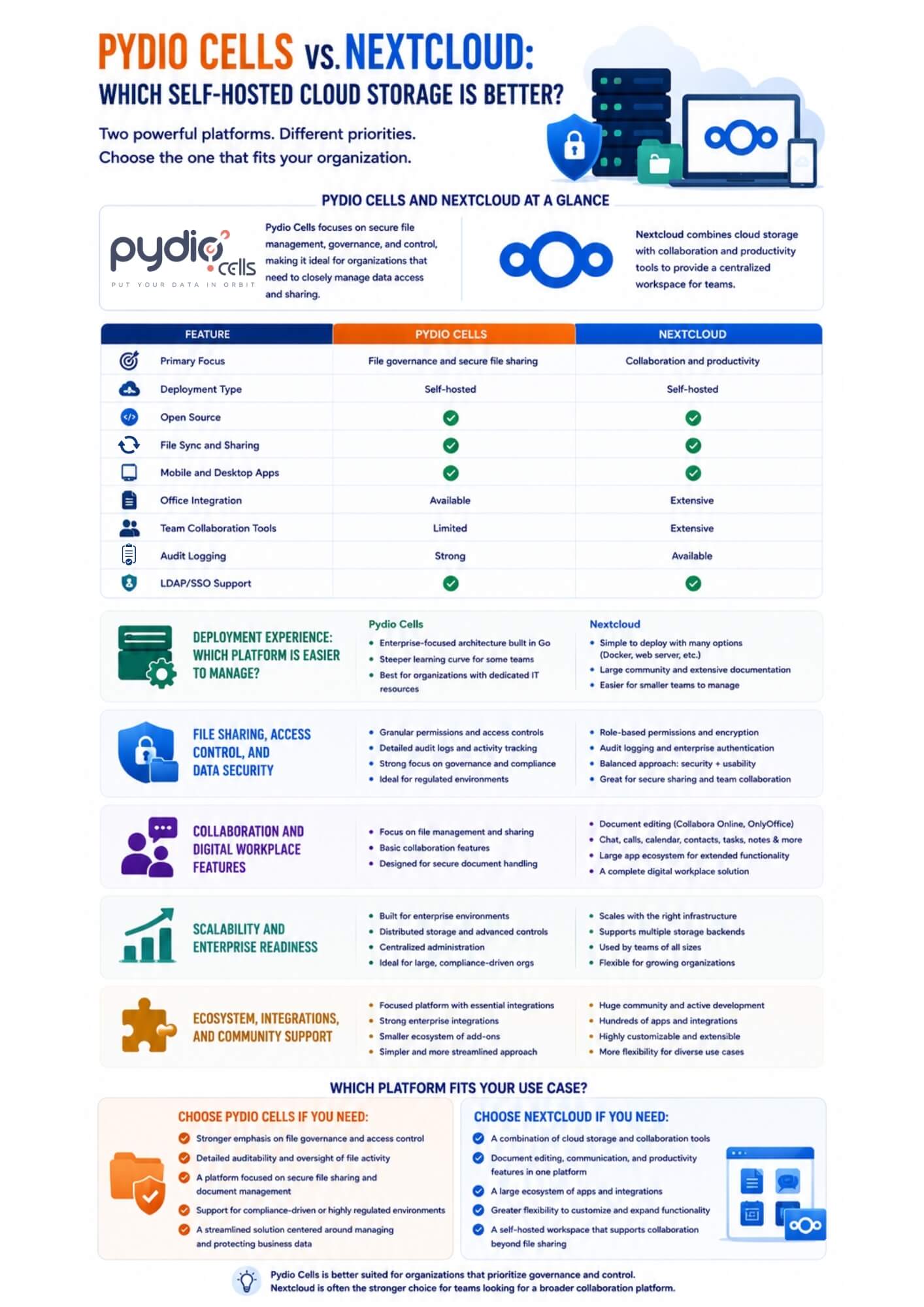
Pydio Cells and Nextcloud are both self-hosted cloud storage platforms, but they serve different purposes. Pydio Cells is best suited for organizations that prioritize file governance, granular access control, auditability, and compliance. Meanwhile, Nextcloud is better suited for teams that need file storage combined with collaboration and productivity tools. The best choice depends on whether your primary requirement is secure document management or a broader self-hosted collaboration platform.
While Pydio Cells and Nextcloud are both self-hosted cloud storage platforms, they are designed with different priorities in mind.
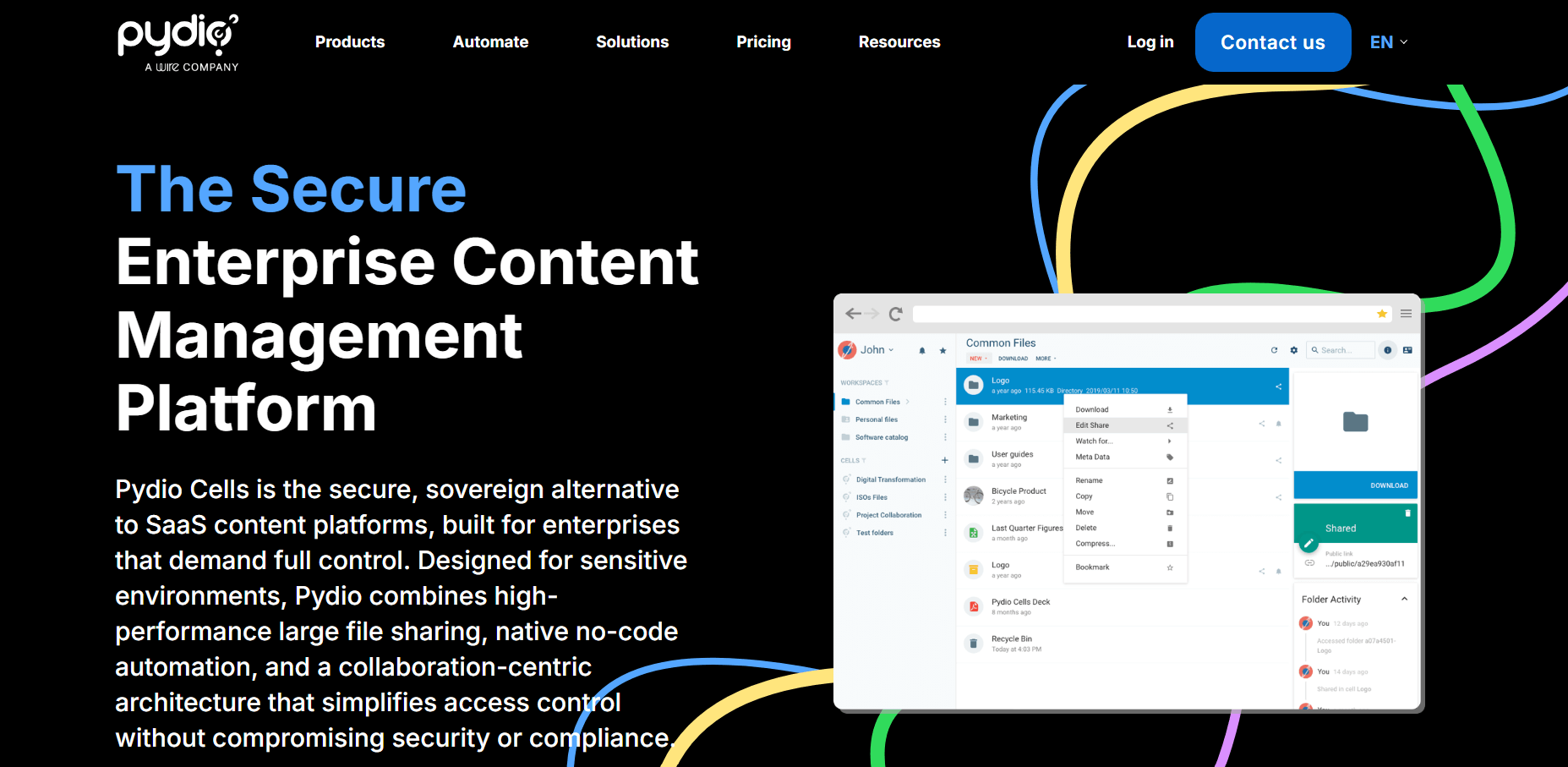
Pydio Cells focuses primarily on secure file management, governance, and control, making it a strong choice for organizations that need to closely manage data access and sharing.
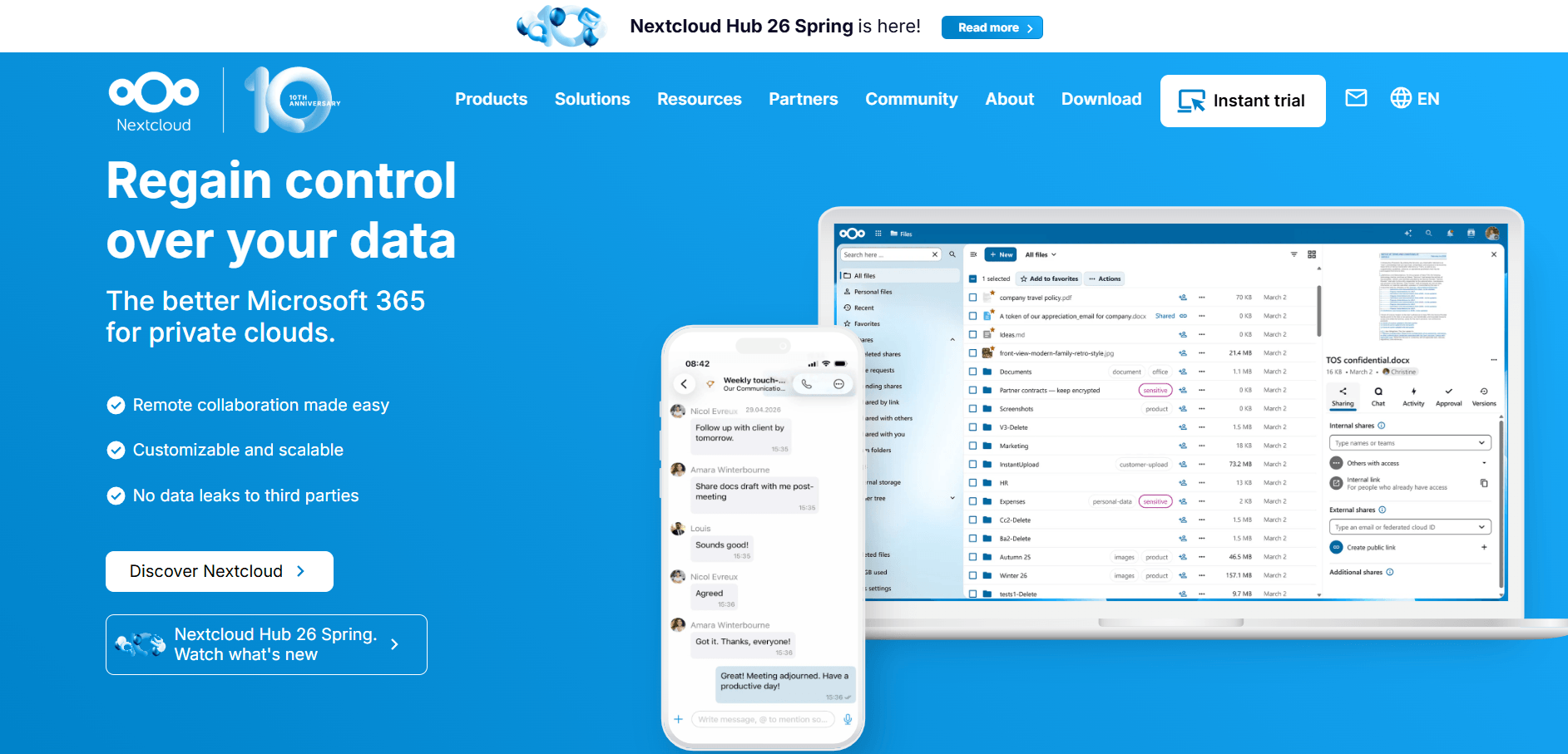
Nextcloud takes a broader approach by combining cloud storage with collaboration and productivity tools. Beyond file sharing, it aims to provide a centralized workspace where teams can manage documents, communicate, and collaborate.
This fundamental difference influences how each platform approaches security, administration, scalability, and day-to-day use.
Both Pydio Cells and Nextcloud can be deployed on-premises or in the cloud, but the administration experience differs.
Nextcloud is widely regarded as the more accessible option due to its extensive documentation, large community, and support for multiple deployment methods, including Docker and traditional web server environments. This flexibility can make it easier for smaller organizations and teams with limited experience in infrastructure to get started.
Pydio Cells is designed with enterprise environments in mind and uses a modern architecture built on Go. While deployment is straightforward for experienced administrators, organizations may face a steeper learning curve compared to Nextcloud, particularly when configuring advanced features and integrations.
For teams seeking the simplest path to deployment and ongoing management, Nextcloud generally has the advantage. At the same time, Pydio Cells may appeal more to organizations with dedicated IT resources and stricter operational requirements. And for those that prefer not to manage servers, updates, and maintenance internally, managed Nextcloud hosting can further simplify deployment and ongoing administration.
The Managed Nextcloud Hosting we provide at CloudBased Backup allows teams to use Nextcloud without the operational overhead of self-hosting, as we handle infrastructure management, security updates, backups, and monitoring.
Both Pydio Cells and Nextcloud provide the core capabilities expected from a secure file-sharing platform, including file synchronization, shared links, user permissions, and support for enterprise authentication methods such as LDAP and single sign-on (SSO). However, they differ in how they approach control and governance.
Pydio Cells places a strong emphasis on access management and file governance. Administrators can define granular permissions, monitor file activity through audit logs, and maintain greater oversight of how data is shared across the organization. These capabilities can be particularly valuable for businesses that must meet internal governance policies or regulatory requirements.
Nextcloud also offers robust security features, including role-based permissions, encryption options, audit logging, and support for enterprise authentication systems. While security remains a core part of the platform, its approach is balanced by collaboration and usability, making it well-suited for organizations that need both secure file sharing and team productivity within a single environment.
Collaboration is one of the areas where Pydio Cells and Nextcloud begin to diverge more noticeably. Pydio Cells focuses primarily on file management and secure document sharing, providing the tools organizations need to access, organize, and collaborate on files while maintaining control over data.
Nextcloud extends beyond cloud storage by offering a broader set of collaboration and productivity features. Through its ecosystem of applications and integrations, organizations can add capabilities such as document editing, calendars, contacts, team chat, video conferencing, and project management tools. This allows Nextcloud to function as a centralized workspace rather than simply a file-sharing platform.
Pydio Cells was designed with enterprise environments in mind and supports features such as distributed storage backends, advanced access controls, and centralized administration, making it well suited for organizations managing large volumes of data and users.
Nextcloud also scales effectively when deployed on appropriate infrastructure and is used by organizations ranging from small businesses to large enterprises. Its flexibility allows administrators to integrate various storage backends, expand functionality through apps, and build environments that support growing teams and workloads.
Nextcloud benefits from a large open-source community, extensive documentation, and a broad library of applications and integrations. Organizations can extend the platform with tools for collaboration, communication, productivity, and external storage, allowing it to adapt to a wide range of use cases.
Pydio Cells takes a more focused approach. Rather than relying on a large ecosystem of add-ons, it concentrates on delivering a streamlined file management and governance experience. While it supports integrations with common enterprise services and authentication systems, its ecosystem is not as extensive as Nextcloud's.
Organizations that prioritize flexibility and customization may find Nextcloud more appealing, while those seeking a more focused file-sharing platform may prefer Pydio Cells' simpler approach.
The right choice depends less on features and more on what your organization is trying to achieve. While both platforms provide secure self-hosted cloud storage, they are optimized for different priorities.
Pydio Cells is just one of many alternatives to Nextcloud. Depending on your requirements, other platforms may be a better fit for file synchronization, document collaboration, privacy, enterprise management, or cloud storage. If you're exploring different options, the following comparisons provide a closer look at how Nextcloud compares to other popular solutions:
Neither platform is inherently better than the other. The right choice depends on how you plan to use your self-hosted cloud storage environment.
If your primary goal is secure file management with strong governance and oversight, Pydio Cells offers a focused solution designed around those requirements. If you need a platform that combines file storage with collaboration and productivity tools, Nextcloud provides greater flexibility and a broader range of capabilities.
Before making a decision, consider not only your current requirements but also how your organization may use the platform in the future. Choosing a solution that aligns with your long-term goals will help reduce complexity and support growth as your needs evolve.
8 min read · 29.09.2026
9 min read · 22.09.2026
5 min read · 14.09.2026
Hosted in
Germany
4.3on G2